

Perspectives
Adam Smith on School Bus Passing Countermeasures
By Adam Smith & Jason Jefferies


Adam Smith
Jason Jefferies, MA
-
Dunlap Research partnered with NHTSA and industry experts to evaluate laws, technologies, and countermeasures aimed at preventing illegal school bus passes and protecting students nationwide.
-
By testing advanced lighting, auditory alerts, and enforcement technologies in real-world and closed-course settings, Dunlap helped identify the most effective tools to increase driver awareness and reduce risk.
-
“Our work demonstrates Dunlap’s ability to apply diverse, data-driven methods tailored to complex safety questions,” said Principal Research Associate Adam Smith. “Every project is designed around what best serves the public.”
As part of the Bipartisan Infrastructure Law, or BIL, Congress directed the National Highway Traffic Safety Administration (NHTSA) to investigate a variety of topics relevant to school bus safety. Specifically, Section 24110(a) mandated a comprehensive review of laws from around the United States relating to illegal passing of school buses, and Section 24110(c) directed NHTSA to review and evaluate various technologies designed to improve school bus safety. Dunlap Research was selected to execute projects designed to tackle both of these objectives. To achieve this, Dunlap collaborated extensively with partners from industry (e.g., Safe Fleet/Seon, First Light, BusGates), academia (e.g., the Virginia Tech Transportation Institute [VTTI]), professional organizations (e.g., the New York Association for Pupil Transportation [NYAPT]), and various local school districts.
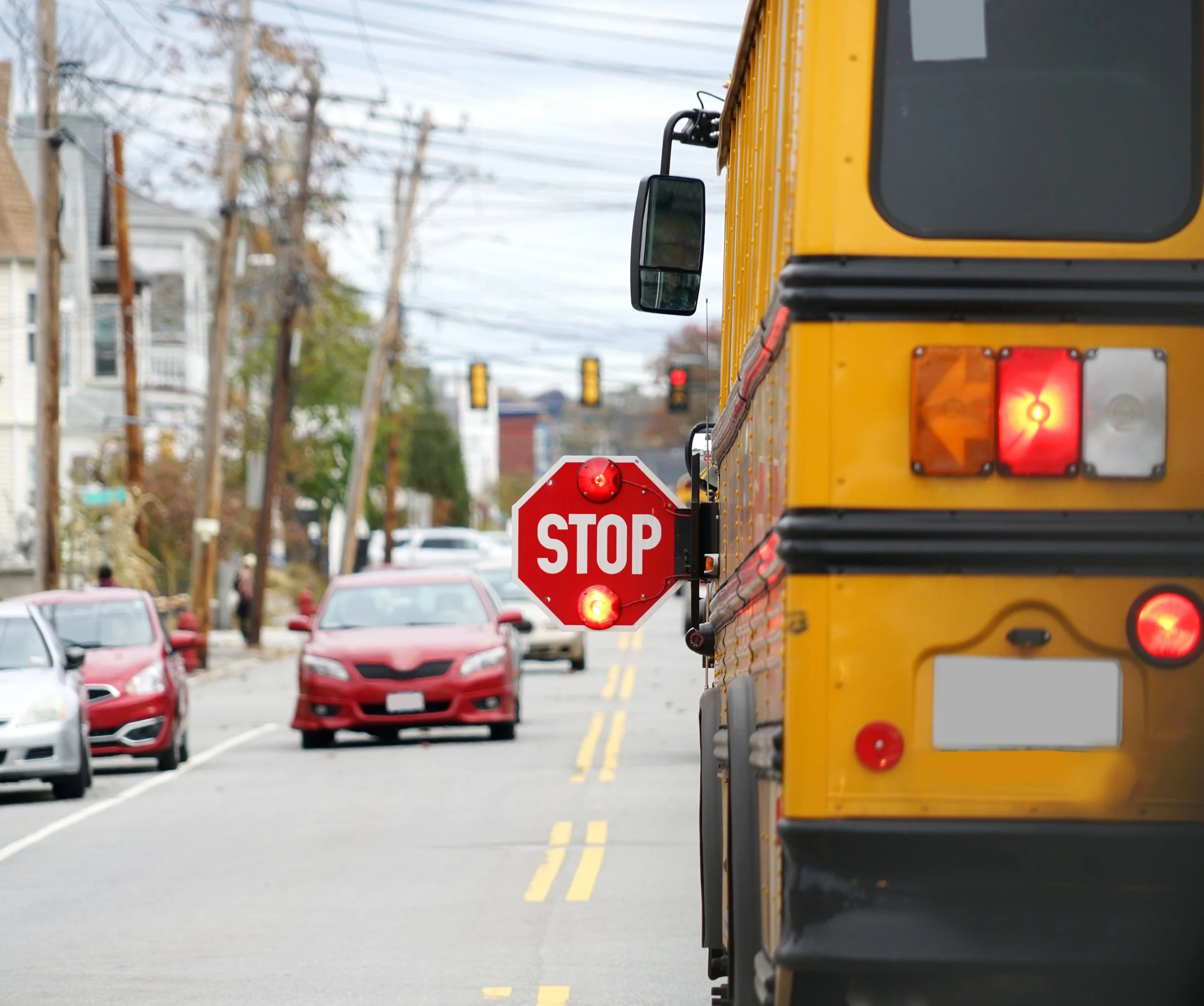
“Unfortunately, there are many instances where school buses picking up or dropping off young students deploy the stop arm, but people pass them anyway,” Dunlap Principal Research Associate Adam Smith said. “What these studies were designed to do was examine the legislative landscape of school bus passing laws around the country and also investigate a variety of countermeasure devices that address the key reasons why these school bus passes might occur.”
What are the key reasons for illegal school bus passes?
“One reason is that people are simply not aware of the legal requirements,” Smith said. There is a lot of variability in the features of school bus passing laws between States, and this variety can sometimes lead to ambiguity. For instance, if you are approaching a school bus that is going in the opposite direction from you on a five-lane highway with a middle turning lane, what do you do? Well, it depends on the State.
“Another reason, the more basic reason, is that people don’t notice the school bus is stopping. Whether they don’t notice because it is dark outside or because the stop arm isn’t well lit, they don’t notice the bus is stopping until it is too late, and that may cause them to swerve around it.
“And the last reason is that people notice the bus is stopping and they know they should stop, but they pass it anyway.”
What did we learn from the law review?
“Unsurprisingly, we confirmed that there is, in fact, a lot of variability in school bus passing laws between States,” Smith said. “The report we published goes into the laws for every State and several U.S. Territories and summarizes the key features of the laws, which in and of itself is a helpful resource.
“That said, I think the most valuable contribution of the report was our ability to boil down some of the recurring elements of these laws and compile them for side-by-side comparison. For instance, it’s one thing to know that penalties for passing a stopped school bus vary by State, but it’s even better to be able to compare the penalties as broken down by fines, license suspensions, jail time, or other features commonly covered in the statutes. For us, seeing which States allow automated enforcement cameras and examining the features of these laws was particularly helpful.”
What types of devices were tested?
“The majority of the devices we tested were advanced lighting devices,” Smith said. “We had an illuminated stop arm, an illuminated school bus sign positioned at the front and back of the bus, and an LED sign with a red ‘stop’ message placed on the back of the bus that would activate when the stop arm was deployed. We also tested an extended stop arm that was equipped with red lighting.
“After these visual countermeasures, we tested auditory countermeasures, where radar detectors that sensed if vehicles were coming from either direction were placed on the buses. If the radar sensed that an illegal pass was imminent, it would issue an audible alert such as STOP, DON’T CROSS.
“We also examined historical data on illegal passes in school districts before and after adopting school bus cameras capable of automatically issuing citations to violators.”
How did we study the effectiveness of these countermeasures?
“In collaboration with our partners at VTTI, we were able to assess the photometric properties of the devices – in essence, the light intensity of the countermeasures relative to standard school bus lighting,” Smith said. “Assessments like this help us to understand the devices as they function on a physical level, which can then be used to help us understand how drivers are likely to perceive these countermeasures in different conditions.
“There was also a closed course study. Drivers encountered a school bus on the course, but they did not know beforehand that they would be encountering a school bus on the course. We had a control group who encountered a bus with no novel countermeasures installed, and other participants saw the bus with one of the enhanced lighting technologies equipped. We observed, using mobile eye-tracking devices and cameras in the vehicles, how drivers behaved when encountering these countermeasure technologies. We tested participants during different times of the day to explore the impact of varying light conditions and also tested them while they were engaged in another task – in our case, periodically looking at simple images on a cell phone. One of the things we were interested in tracking was the difference between the moment when a bus was first able to be seen and when the driver actually looked at the bus.
“We also observed school buses more naturalistically, outside of the closed course, in two separate school systems during the Spring 2024 semester to see if installing the technologies affected illegal passing rates. In fact, we were able to develop a process that allowed us to examine not just the raw number of illegal passes, but the number of illegal passes per bus stop. Developing new metrics like this can help shed new perspective on this issue. For instance, with only a raw estimate of illegal passes it can be hard to compare the potential safety risks of school routes located in different areas that have different numbers of stops. Instead, we looked at the number of illegal passes relative to the number of opportunities where such a pass could happen – in other words, we can use this to calculate the prevalence of illegal passes on a per-stop basis, enabling more meaningful comparisons across distinct route types.”
What was unique about Dunlap’s approach to this study?
“I think this study is a good example of our capacity to employ a variety of methodological techniques,” Smith said. “We aren’t just good at one thing. We have the ability to incorporate a number of approaches that are custom-tailored, precise, and most relevant to the questions of interest. We don’t try to shoehorn in a process just because we’re good at it if it is not the right process to answer the questions at hand. If we do not have the tools to address the project’s needs in the best manner, we have partners who can. We have proven this time and time again.”
About the Experts
Adam Smith
Dr. Smith is a cognitive psychologist who is well-versed in the theoretical properties of cognition and is skilled in both empirical and literature-based approaches of vigorously investigating psychological phenomena in applied settings. As a scientific consultant, he has principally applied these abilities through deployment of user experience, health and safety, and human factors evaluations. The domains in which he has most frequently applied these approaches include traffic safety (e.g., assessing technologies ranging from seat belts to advanced school bus passing countermeasures, investigating effects of substance use on driving capabilities, evaluating the effects of device usage on perceptual, attentional, and navigational capabilities of both drivers and pedestrians) and assessments of user interactions with technologies more broadly (e.g., virtual and augmented reality devices). Dr. Smith has successfully led or participated in research on behalf of government entities (e.g., the National Highway Traffic Safety Administration [NHTSA]), non-profit organizations (e.g., AAA Foundation for Traffic Safety [AAAFTS]), and various Fortune 500 clients in the private sector. Dr. Smith has a demonstrated record of success on projects spanning many areas in the development, assessment, and implementation of technologies and procedures designed to improve safety and usability in a variety of contexts.
Jason Jefferies, MA
Mr. Jefferies is an experienced writer, editor, and project manager with a background spanning journalism, media, and higher education. He has written for publications including VegNews, The Colorado Sun, Aspen Daily News, and WRAL.com, designed websites for multiple organizations, and hosts two podcasts with over 50,000 listeners. At Dunlap, Jason prepares, reviews, and edits scientific and technical reports, proposals, and literature reviews, ensuring accuracy, clarity, and adherence to style standards. He also collaborates with Principal Investigators on project strategies and timelines, manages internal and external communications, and is overseeing the refresh of Dunlap’s website featuring new stories, interviews, and recordings.
Have a Question?
We’d love to hear from you. Reach out to learn more about this topic or discuss your next project with our team.
Contact Us