

Perspectives
Jason Jefferies and Dylan Hewitt on The Post-Crash Care Countermeasures Guide
By Jason Jefferies & Dylan Hewitt

Jason Jefferies, MA
Dylan Hewitt
-
The team evaluated best current countermeasures and best emerging countermeasures for emergency medical services responding to motor vehicle crashes.
-
The guide is intended to provide information to States, local governments, highway safety partners, and other EMS stakeholders to improve crash victim outcomes.
-
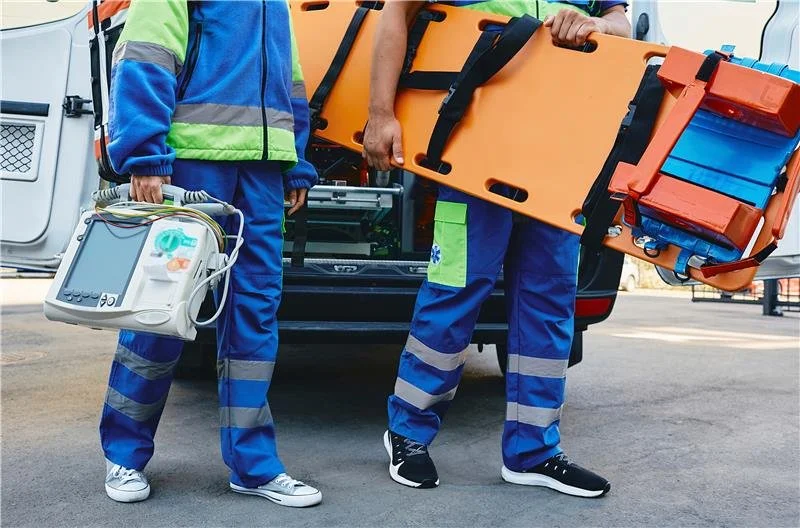
The Post-Crash Care Countermeasures Guide works to improve the safety of EMS staff as they work to save lives when responding to MVC incidents.
The Post-Crash Care Countermeasures Guide provides details on effective emergency medical services (EMS) countermeasures related to responses to motor vehicle crashes (MVCs). The guide is intended to provide information to States, local governments, highway safety partners, and other EMS stakeholders to improve crash victim outcomes, as well as the safety of EMS staff as they work to save lives when responding to MVC incidents. The Post-Crash Care Countermeasures Guide includes four chapters covering Automatic Crash Notification and Call Routing; System Preparedness; Response to the Scene and Scene Safety; and On-Scene Care, Triage, and Transport. Each chapter includes descriptions of countermeasures, their effectiveness, estimated cost to implement, and time to implement.
“The Post-Crash Care Countermeasures Guide is based on another guide called Countermeasures that Work,” co-author Jason Jefferies says. “What Countermeasures that Work does is provide a lot of options (countermeasures) for ways that a person or organization can respond to various situations and then rate the provided countermeasures within a five-star system. We used Countermeasures that Work as a template for various EMS responses to MVCs. Initially, there were several subject areas that ended up getting whittled down to four, which were Crash Notification and 911 Call Routing, System Preparedness, Response to the Scene and Scene Safety, and On-Scene Care, Triage, and Transport.”
“It's necessary for EMS to know how to respond to crashes safely and efficiently,” Jefferies continued. “For the safety of the people who are responding and for crash victims who oftentimes need care and attention in the most correct and efficient manner. With MVCs, delays of just a few seconds or minutes can mean the difference between life and death.”
“This project specifically focused on MVCs,” co-author Dylan Hewitt says. “Not on the entirety of EMS. And MVCs have very unique requirements for emergency medical services. With a gunshot wound, you're usually not having to pry somebody out of a vehicle like you are with an MVC. There's less chance of an engine exploding. With MVCs, you’re dealing with things that no other type of injury is dealing with. This is especially relevant with things like pre-hospital blood transfusions, which is currently a hot topic in EMS research. EMTs on-scene at a MVC don’t have the luxury of a full hospital setup, and sometimes a blood transfusion en-route to the hospital could spell the difference between life and death for the patient, so finding resources for EMS professionals and compiling the current research on pre-hospital blood transfusions could be critical.”
Would you say the intended audience for this is the more academic/research side or is this more of a practical guide?
“I think that this could be a practical guide for anyone working in EMS,” Jefferies says. “But it's likely more for administrators who need to choose the most appropriate countermeasures to implement within their specific units. The guide can be used as an administrative decision-making tool.”
Do you have any personal interests in the project?
“One of my childhood friends is nurse in a Level 1 Trauma Center,” Hewitt says. “She sees everything. Because of our work here at Dunlap Research, we talk a lot about things like motorcycle safety or occupant protection relative to the injuries that she sees all the time. Working on this felt like I was able to help my friend. She sees this stuff firsthand. Getting to talk to her about this guide and hearing from somebody in the field that this could potentially make an impact has been a big deal. If EMS can help somebody before they get to the hospital, that's less mental, physical and fiscal resources needed for that case.”
“I think a lot of people want to work on something that has the ability to make a difference in the world or in someone else's life,” Jefferies says. “Most of the projects we work on at Dunlap Research do that, but this one more than most. If you consider that EMS might receive this guide and, as a result, implement a service that allows them to respond to a crash victim two minutes faster, it can save that person’s life. If this happens, we’ve made a huge difference in the world. And I feel like this guide has the potential to do that over and over again.”
About the Experts
Jason Jefferies, MA
Mr. Jefferies is an experienced writer, editor, and project manager with a background spanning journalism, media, and higher education. He has written for publications including VegNews, The Colorado Sun, Aspen Daily News, and WRAL.com, designed websites for multiple organizations, and hosts two podcasts with over 50,000 listeners. At Dunlap, Jason prepares, reviews, and edits scientific and technical reports, proposals, and literature reviews, ensuring accuracy, clarity, and adherence to style standards. He also collaborates with Principal Investigators on project strategies and timelines, manages internal and external communications, and is overseeing the refresh of Dunlap’s website featuring new stories, interviews, and recordings.
Dylan Hewitt
Mr. Hewitt is an experienced researcher with a wide range of skills including literature review, editing and quality assurance, participant research, and user experience evaluation. He is an expert on APA and NHTSA formatting of reports and documents and proficient in Microsoft Excel and R. He has assisted in a variety of projects at Dunlap and Associates, and in his academic career has developed and implemented several projects investigating impacts of font and screen characteristics on digital reading.
Have a Question?
We’d love to hear from you. Reach out to learn more about this topic or discuss your next project with our team.
Contact Us